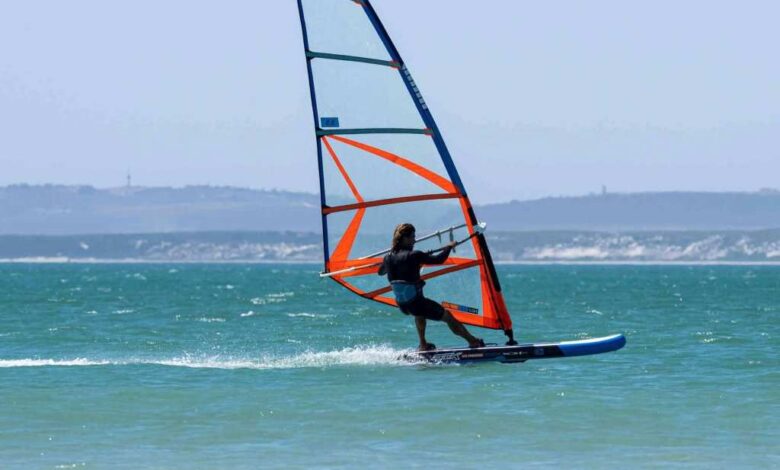
The windsurfing board, a harmonious blend of surfboard and sailboat, has captivated water sports enthusiasts for decades. This dynamic craft offers a unique experience, allowing riders to harness the wind’s power and glide across the water’s surface with grace and exhilaration.
Evolution of Design: From Primitive to Performance
In its early days, windsurfing boards were rudimentary, resembling oversized surfboards with makeshift sails. However, advancements in materials and design have transformed these boards into high-performance machines. Modern windsurfing boards are typically constructed from lightweight yet durable materials like epoxy, carbon fiber, and fiberglass. These boards feature specialized shapes, fins, and footstraps to optimize control, speed, and maneuverability. Additionally, custom windsurfing boards cater to enthusiasts seeking personalized equipment tailored to their specific preferences and needs within the windsurfing community.

Types of Windsurfing Boards: A Board for Every Style
Windsurfing boards come in various shapes and sizes, each catering to different skill levels and riding preferences.
- Freeride Boards: These versatile boards offer a balance of stability and maneuverability, making them ideal for beginners and intermediate riders. Freeride boards are designed for cruising, carving turns, and performing basic jumps.
- Wave Boards: As the name suggests, wave boards are built for riding waves. These boards are shorter and narrower than freeride boards, allowing for greater responsiveness and control in surf conditions. Wave boards excel at performing aerial maneuvers and carving through powerful waves.
- Freestyle Boards: Freestyle boards are designed for performing tricks and aerial maneuvers. These boards are typically shorter and wider than other types, providing a stable platform for executing spins, slides, and other acrobatic moves.
- Formula Boards: Formula boards are the fastest and most high-performance windsurfing boards. These boards are designed for racing and are characterized by their large sails and specialized daggerboards for maximum speed and upwind performance.
- Slalom Boards: Slalom boards are designed for speed and agility. These boards are typically narrower than freeride boards, allowing for quick acceleration and sharp turns. Slalom boards are used in slalom racing, a discipline that involves navigating a course marked by buoys.
The Art of Windsurfing: A Symphony of Skill and Technique
Windsurfing is a sport that demands a unique blend of physical skill, technical knowledge, and an intuitive understanding of the wind and water. The rider must learn to balance on the board, control the sail, and harness the wind’s power to propel themselves across the water. Windsurfing techniques vary depending on the rider’s skill level and the type of board being used. Beginners typically start by learning basic maneuvers like tacking (changing direction by turning the board through the wind) and jibing (changing direction by turning the board away from the wind). As riders progress, they can learn more advanced techniques like jumping, carving turns, and performing aerial maneuvers.
Windsurfing as a Lifestyle: A Community of Passionate Enthusiasts
Windsurfing is more than just a sport; it’s a lifestyle. Windsurfers are a passionate community of individuals who share a love for the water, the wind, and the freedom of riding a windsurfing board. Many windsurfers travel the world in search of the perfect wind and waves, while others simply enjoy cruising around their local lakes and bays. Windsurfing is a sport that can be enjoyed by people of all ages and skill levels. It’s a great way to get exercise, enjoy the outdoors, and connect with nature.
The Future of Windsurfing: Innovation and Sustainability
The future of windsurfing looks bright, with ongoing innovation and a growing emphasis on sustainability. Manufacturers are constantly developing new materials and designs to make windsurfing boards lighter, faster, and more durable. There’s also a growing trend toward eco-friendly windsurfing practices, with manufacturers using recycled materials and developing more efficient production methods. As the world becomes more environmentally conscious, windsurfing is well-positioned to be a leader in sustainable water sports.